
Why Tired Hands Make Mistakes, and How Science Can Help
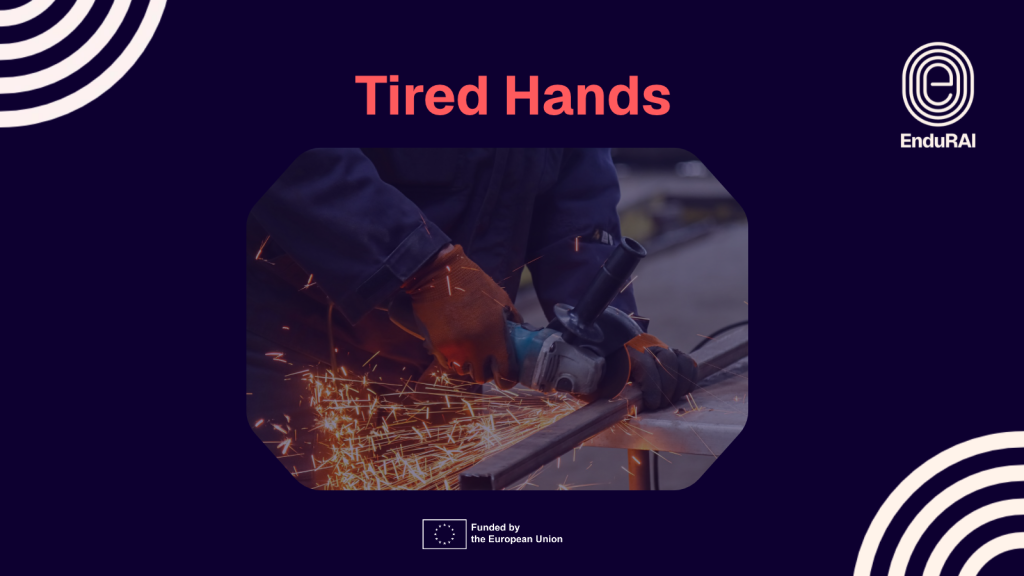
Tired employees make more mistakes: why? A quick look at how fatigue affects the body and how EnduRAI is working to detect it early.
What really happens when we get tired, and can we feel it earlier?
All movements begin with a tiny electrical signal. Your brain tells it, and your muscles obey. Those signals shift when you repeat the same move for hours, and those muscles start to tire.
The outcome is apparent, but not obvious. Your grip weakens, maybe with some shaking, and holding a tool at the right angle gets harder. Your attention also weakens, making you miss small slips.
None of these implies negligence. It’s just a fact of life.
The problem of late discovery of errors
Take welding. A wobbly hand or an incorrect torch angle can weaken a joint. Most of these issues, however, are encountered only at the end, during the final inspection, which mainly reflects the quality of the work performed.
At that time, the part needs to be repaired or discarded. Wastage of time and materials. And a worn-out worker has been overlooked throughout.
That is, we have no problem identifying the error. Whereas we’re not so great at detecting it.
Lack of sleep or fatigue is hard to quantify
Cameras and motion sensors have already been employed in factories. Useful, but only so far as they recognise our movement, not the effort our muscles put in.
Two people can perform the same movement. One is in good shape, the other is running on empty. Looks the same on the outside. The difference is that early signs of tiredness occur beneath the surface before anyone can see them.
The research areas EnduRAI is investigating
A new idea is being tested in a European research project called EnduRAI, which stands for End User The Research Approach In Earthing, and aims to hear what the muscles are saying.
A wristband uses a technique called sEMG to pick up the small electrical signals in the forearm through the skin. These signals are then combined with data on the tasks themselves, like images captured with a camera of a weld, for example, by a computer system powered by AI. If both point to a problem, then the worker receives a gentle vibration on the wrist. A straightforward reminder to stop or adjust prior to the error.
The concept is being piloted at two industrial sites, one in Spain (a pulley plant) and another in Türkiye (a shipyard). The initial objective is to reduce fatigue-related errors by 10% or more.
What we don’t yet know
Honest questions are the first step to good science. Can a wristband reliably pick up muscle signals despite sweating, machine noise, and dust? Will the alerts be useful or annoying to workers? And will it work equally well for people of different ages, genders and body types?
This is precisely what the project aims to answer, in real workplaces, with real workers involved from the start.
Fatigue isn’t a deficiency. It’s a part of human life. This is the kind of smart technology that could be the best, helping us take care of ourselves before minor problems escalate into big ones.